

Why Airlines Are Opposing the New Passenger Rights
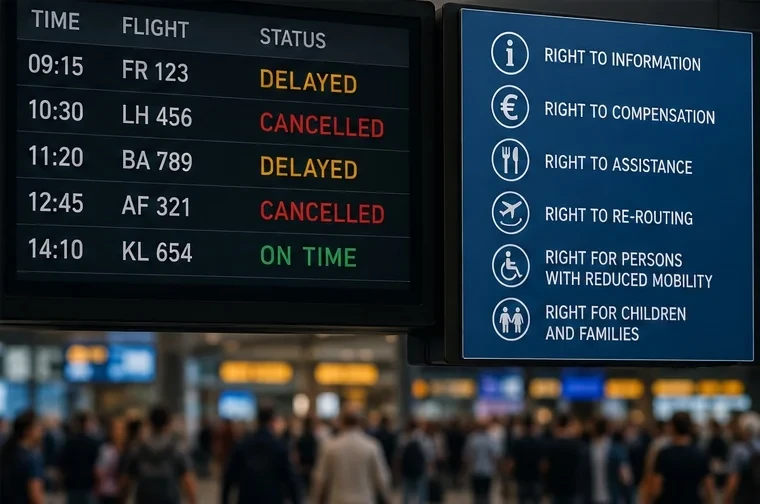
The provisional agreement on changes to air passenger rights was welcomed by the European institutions and consumer organisations, but it also prompted strong objections from parts of the aviation sector.
The main dispute concerns the cost of stronger consumer protection. Airlines argue that broader obligations concerning compensation, passenger care and rerouting will increase their operating costs. From the consumer perspective, predictable compensation gives carriers an incentive to plan more reliably and prevents them from transferring the consequences of disrupted flights to passengers.
Which Airlines Have Already Expressed Opposition?
Ryanair
Ryanair responded immediately after the provisional agreement was reached on 15 June 2026.
The company opposed the decision to retain the three-hour compensation threshold and the proposed way in which fares including cabin baggage must be displayed. According to Ryanair, this could increase the initial ticket price shown to passengers who do not want additional cabin baggage.
This is the airline’s own position. It is not proof that all airfares will necessarily increase.
Lufthansa Group
Lufthansa Group has also warned that expanding passenger rights could increase costs and ticket prices.
According to officially published figures, the group paid more than €500 million in compensation under the existing air passenger rights rules in 2024.
For the first quarter of 2026, Lufthansa Group reported:
- €73 million in passenger care and assistance costs;
- €55 million in direct compensation for delayed and cancelled flights.
These are actual costs incurred under the current system. They are not losses already caused by the proposed reform.
What Is the Position of Aviation Organisations?
The International Air Transport Association, Airlines for Europe and the European Regions Airline Association have repeatedly objected to parts of the proposed changes.
IATA estimates the total annual regulatory burden of the current system at approximately €8 billion.
In an earlier analysis, aviation organisations argued that the version of the reform being considered at that time could increase the sector’s annual costs by at least 40% and make some routes economically unsustainable.
That forecast concerned an earlier draft, not the final compromise announced on 15 June 2026. It is also an industry estimate and should not be presented as an independently verified amount of future losses.
The position of an aviation association should not automatically be attributed to every airline that belongs to it unless the individual carrier has issued its own statement.
How Will the New Rules Affect Air Carriers?
Companies that sell the basic ticket separately from baggage, seat selection, boarding passes and other services will have to adapt the way in which they present prices.
They are likely to be affected most strongly by the transparency requirements, free seating for children next to an accompanying adult and restrictions on certain administrative charges.
When a ticket is sold at a low price, compensation of €250 or €400 may be several times higher than the revenue earned from the individual passenger.
On routes with low passenger demand, the additional financial risk could result in less frequent services, higher prices or the withdrawal of unprofitable routes.
Large network airlines may face compensation of up to €600, disruption involving connecting flights and more expensive rerouting with competing carriers. However, they also have larger networks, more alternative flights and greater capacity to redistribute affected passengers.
Can Airlines Stop the Reform?
While the legislative procedure is still ongoing, airlines and their representative organisations can submit opinions, lobby for amendments and participate in the public debate.
Once the regulation has been formally adopted, they cannot unilaterally refuse to comply with it.
Airlines may challenge specific decisions made by national authorities before a court. They may also seek an interpretation from the Court of Justice of the European Union through national judicial proceedings.
However, these legal options do not give carriers the right to disregard the common rules.
Can Airlines Circumvent the New Passenger Rights?
It is more accurate to speak of airlines adapting their business models than to assume that they will automatically attempt to circumvent the rules unlawfully.
Possible responses include:
- increasing the basic ticket price;
- transferring part of the costs to other optional services;
- changing baggage packages;
- adding more buffer time to flight schedules;
- reducing the frequency of services on weaker routes;
- applying stricter operational risk management policies.
Some carriers may attempt to rely more frequently on extraordinary circumstances when rejecting compensation claims.
The new text seeks to limit this practice by placing the burden of proof on the airline and requiring a direct connection between the extraordinary circumstance and the specific disrupted flight.
The agreed rules also restrict practices such as requiring passengers to use a mobile application, forcing them to create an account or refusing reasonable rerouting options.
Will Airfares Increase?
An increase is possible, but it is not automatic and cannot be calculated in the same way for every route.
The European Commission has confirmed that airlines retain the freedom to set their own prices. This means they may incorporate some of the additional costs into their fares.
The actual effect will depend on:
- the level of competition;
- passenger demand;
- the type of route;
- the frequency of flight disruptions;
- each airline’s ability to improve its operational reliability.
On highly competitive routes, carriers may find it difficult to pass all additional costs on to passengers. On routes with fewer alternatives, the risk of higher prices may be greater.
Which Proposals Were Dropped or Changed?
During the negotiations, the Council’s original position that compensation should only become payable after delays of four or six hours was not accepted. The three-hour threshold was retained.
The proposal to limit the maximum compensation to €500 was also rejected. Compensation of €600 was retained for the longest flights.
On the other hand, the European Parliament did not secure all of its original demands:
- the list of extraordinary circumstances will remain open rather than fully exhaustive;
- a free second item of cabin baggage weighing up to seven kilograms was not guaranteed for all fares;
- airlines will be allowed to offer a cheaper fare that does not include standard cabin baggage;
- some earlier proposals concerning airport contact points and mandatory insolvency protection mechanisms are not included in the announced compromise.
Other deadlines were agreed as a compromise between the positions of the negotiating parties.
Passengers will have nine months to submit a claim, while airlines will have 30 days to make a decision.
Frequently Asked Questions
Can an Airline Introduce a New Fee Instead of Increasing the Ticket Price?
Yes, provided that the fee is lawful and clearly disclosed before the purchase is completed. Mandatory elements of the total price cannot be hidden.
Can an Airline Refuse Compensation Because of a Strike?
It depends on the type of strike and the specific circumstances. The airline must prove that the case qualifies as an extraordinary circumstance and that it took all reasonable measures.
Who Ultimately Pays for the New Passenger Rights?
Initially, the cost is borne by the airline. Part of it may be reflected in ticket prices, but competition and consumer behaviour limit the extent to which all additional costs can automatically be passed on to passengers.
Funded by the European Union. Views and opinions expressed are however those of the author(s) only and do not necessarily reflect those of the European Union or European Innovation Council and SMEs Executive Agency (EISMEA). Neither the European Union nor the granting authority can be held responsible for them.