


Consumer rights in online purchases in 2026: what is changing and when you can return a product
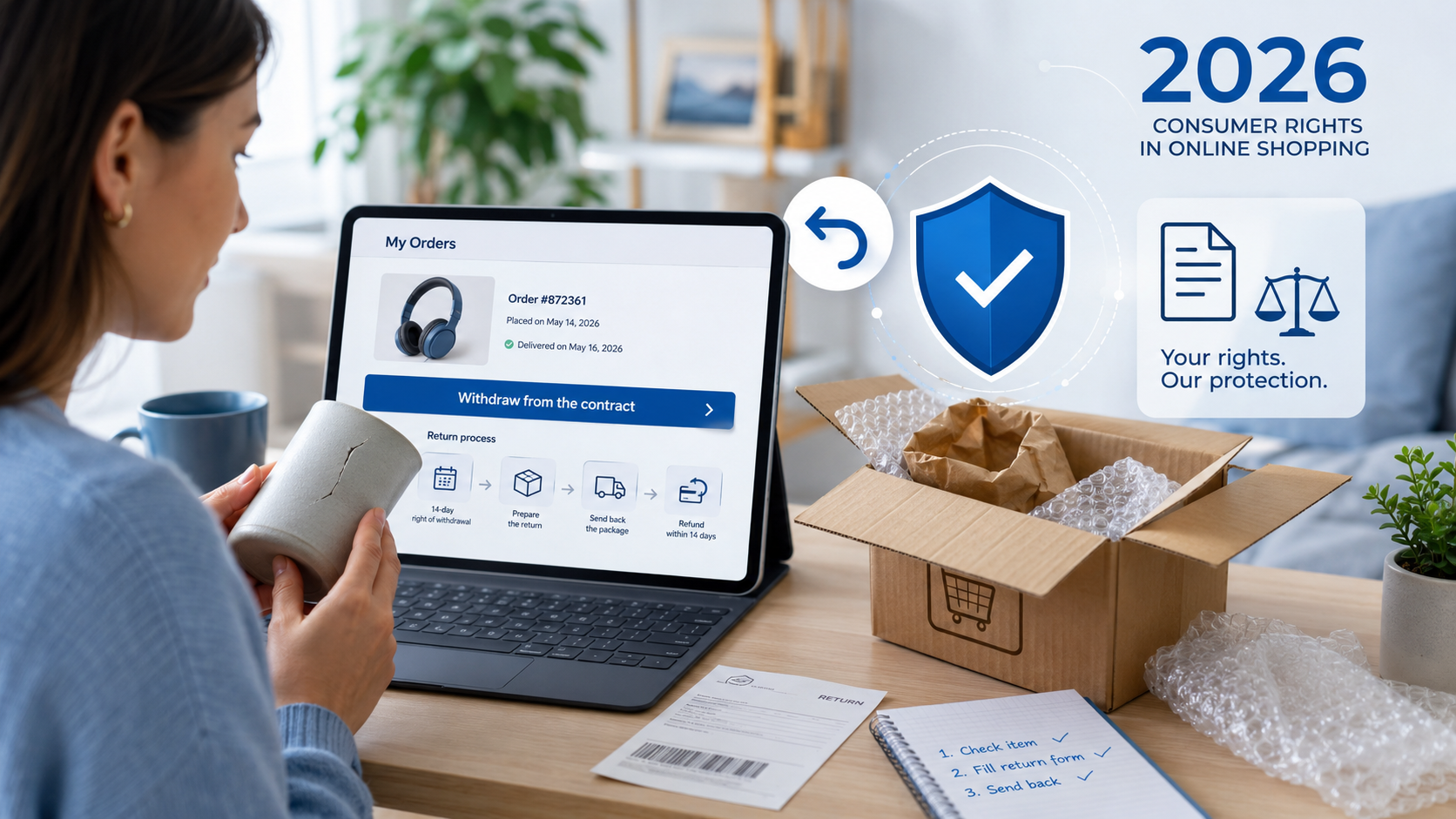
Online shopping is convenient, but it often raises questions: can I return a product if I do not like it; what happens if I have torn the packaging; are there products that cannot be returned; and what changes in 2026?
In 2026, there are several important changes in consumer law. Some of them are already in force, others should have been introduced, and others are yet to start applying.
Online purchases and the right of withdrawal
When making an online purchase, the consumer generally has the right to withdraw from the contract within 14 days. This means that they can return the product without giving a reason.
The period usually starts from the moment the goods are received. The consumer must first notify the trader that they are withdrawing from the contract and then return the product within the prescribed period.
Example: You order a jacket online. You receive it on Monday, try it on at home and see that the size is not right. You can notify the trader that you are withdrawing from the purchase. You do not need to prove that the product is defective.
The new withdrawal button
One of the important changes in 2026 is the new European requirement for an electronic withdrawal function. The idea is simple: if you have bought something online, you should also be able to withdraw from the contract online in an easy way.
At EU level, the rule starts applying from 19 June 2026. However, Bulgaria has delayed the transposition of the directive into national legislation. The motives to the Bulgarian draft law state that the European Commission has opened infringement proceedings against Bulgaria for failure to notify the transposition measures on time.
Nevertheless, consumers should know the direction of the change: online traders are expected to provide a clear function such as “Withdraw from the contract here”, through which withdrawal can be submitted directly via the website or app.
When there is no right of withdrawal
The law provides for exceptions. The trader may have grounds to refuse a return if the product falls within a specific legal category.
Examples of goods and services for which there may usually be no right of withdrawal include:
- goods made to the consumer’s specifications - for example jewellery engraved with a name or furniture made to exact measurements;
- goods with a short shelf life - for example fresh food, cakes, flowers;
- sealed goods which have been unsealed and cannot be returned for health or hygiene reasons - for example a toothbrush, razor, some cosmetic products, underwear under certain conditions;
- goods which, after delivery, have been inseparably mixed with other goods - for example fuel or bulk material;
- sealed audio or video recordings and software, if they have been unsealed;
- digital content where the supply has begun with the consumer’s express consent and the consumer has confirmed that they lose the right of withdrawal;
- services that have already been fully performed with the consumer’s consent under the legal conditions.
Example: If you buy a standard vacuum cleaner online and only unpack it, this alone does not automatically mean that you lose your right of withdrawal. But if you buy a sealed electric toothbrush and unseal it, the trader may rely on health and hygiene reasons.
Does torn packaging mean that I cannot return the product?
Not always. This is one of the most common disputes.
The mere tearing or opening of the packaging does not automatically mean that you lose your right of withdrawal. The consumer has the right to inspect the goods in the same way as they could in a shop - to see them, try them carefully, and establish their characteristics and functioning.
But there is a difference between inspection and actual use.
Example: You buy shoes online. You can try them on at home on a clean floor. But if you go outside with them and the soles become worn, the trader may claim reduced value.
Example: You buy a phone. You can turn it on and check whether it works. But if you scratch it, drop it, or return it without the cable and accessories, a dispute may arise over reduced value.
Damaged goods upon return
If the product is damaged, this does not always mean that the trader can simply refuse to accept it back. However, the consumer may be liable for the reduced value if they have handled the product more than necessary to inspect it.
This means that the trader may refund a smaller amount if there is a proven loss of value. However, this amount must be reasonable and linked to the actual condition of the product, not an arbitrary penalty.
Example: You order an office chair. You assemble it carefully, sit on it briefly and realise that it is not comfortable for you. This is close to normal inspection. But if you use it for two weeks, scratch the legs and tear the upholstery, the trader may claim reduced value.
What to do if you want to return an online purchase
If the trader has provided a button or electronic function for withdrawing from the contract, use it. This is the most direct way to submit your withdrawal, because the system should confirm the request and record the date and time of submission.
If such a function is missing, does not work or has not yet been introduced, notify the trader in writing in another provable way - through a standard withdrawal form, email or another clear statement. It is important to keep proof of when you sent the withdrawal.
Then follow the instructions for returning the goods. It is best to keep the order number, a copy of the message, the confirmation from the trader and the courier document.
What else is changing in 2026
Consumers receive stronger protection against unfair commercial practices. If the contract was concluded because of a misleading practice, the consumer may seek a price reduction, termination of the contract or compensation.
From 27 September 2026, clearer rules against misleading “green” claims should also apply. This means that traders should not use general expressions such as “eco”, “green” or “sustainable” if they cannot prove them.
Conclusion on the right of withdrawal
The right of withdrawal in online purchases is an important protection, but it is not a right to use a product without limitation and then return it as new. The consumer has the right to inspect the goods. The trader has the right to protect their value if the goods are damaged or used excessively.
The best protection for both sides is clear communication: a visible withdrawal process, clear deadlines, correct description of exceptions and evidence for every step.
Frequently asked questions
Can I return a product bought online if I simply do not like it?
Yes. As a rule, with an online purchase you have the right to withdraw from the contract within 14 days, without giving a reason.
When does the 14-day period start?
Usually, the period starts from the day you receive the goods. If several products from one order are delivered separately, the period may start from the receipt of the last product.
Do I have to use the withdrawal button?
If the trader has provided such a button or electronic function, it is best to use it. This makes it easier to prove when you submitted the withdrawal.
What should I do if there is no withdrawal button?
Your right of withdrawal does not disappear. Notify the trader in another provable way - through a standard form, email or a clear written statement.
Can I return a product with opened packaging?
In many cases, yes. The mere opening of the packaging does not automatically mean that you lose your right of withdrawal. An exception may apply to some sealed health or hygiene products.
Can the trader refund me a smaller amount?
Yes, if you have used the goods more than necessary to inspect them and this has reduced their value. For example, in cases of scratches, missing accessories or visible wear.
Which goods most often cannot be returned?
Most often, these include goods made to individual order, perishable products, some unsealed hygiene goods, unsealed software, digital content under certain conditions and services that have already been fully performed.
What evidence should I keep?
Keep the order number, the withdrawal message, the trader’s confirmation, the courier waybill and photos of the goods before sending them back.
What changes for consumers in 2026?
The changes are aimed at easier online withdrawal from contracts, better protection against misleading commercial practices and clearer rules against unproven “green” claims.
Funded by the European Union. Views and opinions expressed are however those of the author(s) only and do not necessarily reflect those of the European Union or European Innovation Council and SMEs Executive Agency (EISMEA). Neither the European Union nor the granting authority can be held responsible for them.